
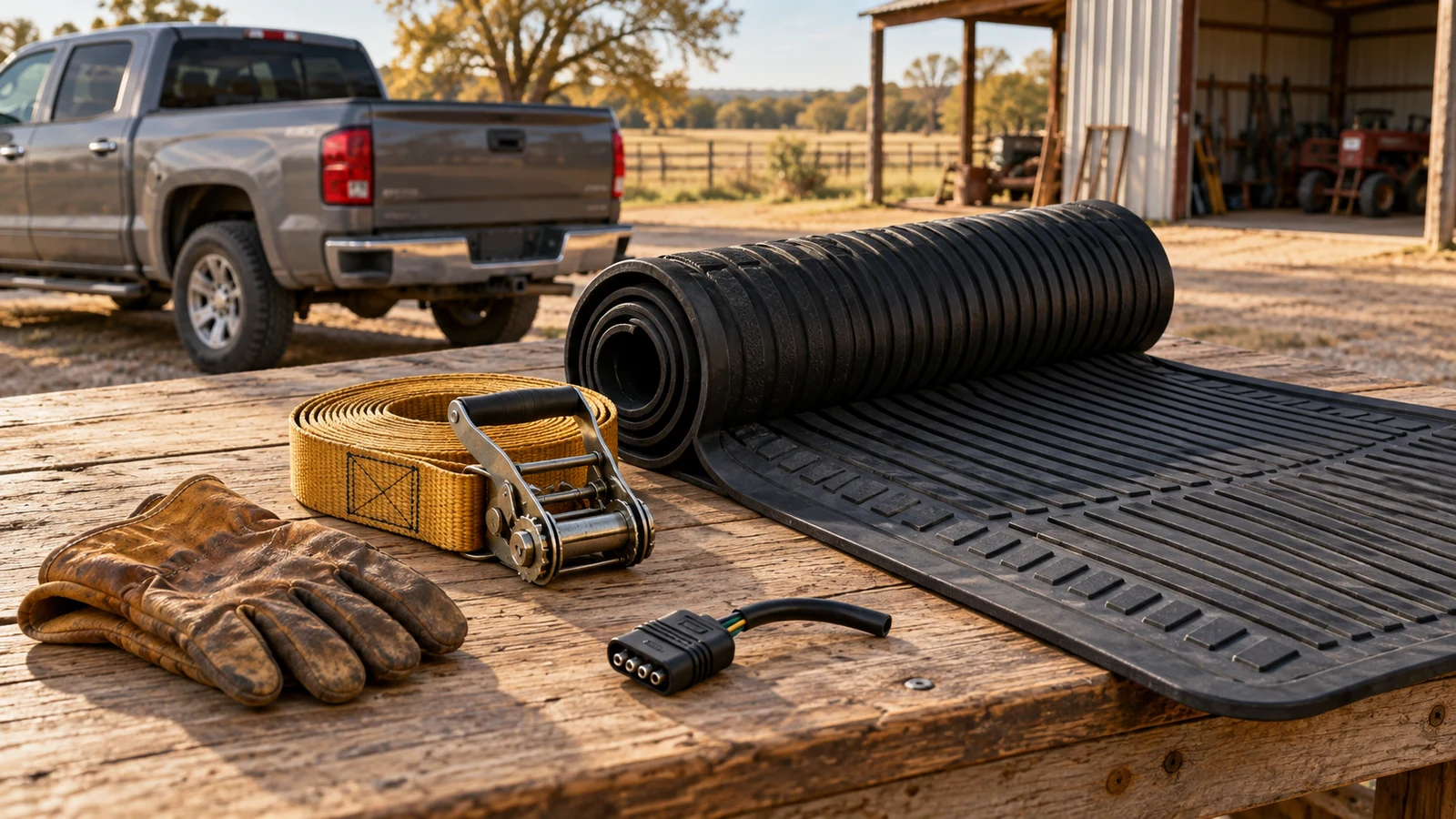
November is when a pickup in Wise County stops being transportation and turns into equipment. Hay moves, feed moves, deer leases fill up, firewood gets hauled, contractors push to close out jobs before the weather turns, and daylight quits somewhere around five-thirty. Decatur sits at the US-380 and US-287 crossroads as the county seat, which means most of that hauling traffic passes through town on the way to somewhere else. The trucks that handle the season well are not the newest ones. They are the ones set up on purpose - a bed that does not chew up cargo, a toolbox that keeps the right tools within reach, straps rated for the load instead of whatever was in the corner of the garage, and lights that work when the sun is already down. This is a walkthrough of the accessories that actually earn their keep on a working truck, what changes depending on whether you run ranch roads, lease roads or the I-35W commute, and how to think about the choices before you spend a Saturday on the install.
Start With the Bed: Liners and Mats
The bed floor takes more abuse than any other surface on a working truck, and it is also the surface that quietly costs the most when it fails. Bare painted sheet metal under a season of pallets, tool buckets, T-posts, feed sacks and gravel picks up scratches that turn into rust, and rust in a bed floor is not a cosmetic problem for long.
There are three broad approaches. A drop-in bed liner is a molded plastic shell that sits in the bed and takes the impacts. It is the most protective option against dropped hardware and dragged steel, and it is removable when you need the bed back. The tradeoff is that grit and moisture can get between the liner and the bed, so it needs to come out and get cleaned occasionally, and cargo tends to slide on the smooth surface.
A bed mat is a heavy rubber or composite mat that covers the floor only. It grips cargo instead of letting it slide, it dampens noise, it is easy to pull out and hose off, and it does not trap much beneath it. It leaves the bedsides exposed, so it suits trucks that haul heavy things onto the floor rather than trucks that get loaded from the side with equipment banging the walls.
Bedside and rail protection covers the parts people forget. Tailgate and bed rail caps take the scrapes from loading, from setting a toolbox down, from a strap dragged over the edge a hundred times. A truck that gets loaded and unloaded daily earns them.
For a ranch truck hauling feed and fencing supplies, a mat with grip is often the more practical choice because the load needs to stay put on a rough county road. For a contractor truck loaded with tools, lumber and buckets, the full protection of a drop-in liner makes more sense. Our pickup truck accessories selection is built around that working-truck mix rather than show trucks.
Toolboxes: Crossbed Versus Side-Mount
A toolbox turns a truck bed from a cargo area into a work platform, and the style decision comes down to what else lives in the bed.
Crossbed boxes mount at the front of the bed against the cab, spanning the bed rails. They give the most secure storage volume of any style, they are easy to reach from either side, and the classic gull-wing lid opens without stepping into the bed. Because they sit above the floor line, they cost you a strip of bed length but almost no usable floor. This is the default for a truck that carries hand tools, straps, chains, jumper cables and a small parts stash every day. Look at mounting hardware and how the box seals along the lid, because a box that lets water in becomes a rust box for everything inside it.
Side-mount and low-profile boxes run along the inside of the bedside, above the wheel well or along the rail. They leave the floor and the front of the bed open, which matters when you regularly carry something long or bulky - fencing, pipe, a pallet, a mower. Two side boxes can give you good separated storage while keeping the floor clear.
Chest and utility boxes sit on the bed floor at the front and are the choice when you want storage that can be removed with two people and a hand truck, or moved between trucks.
Whatever style you pick, the practical details matter more than the shape: a lock that holds up to weather, gas struts or a prop that keeps the lid up in wind, weather stripping that still seals in year two, and a mounting method that clamps solidly without letting the box walk under load. A toolbox that shifts while you drive will wear through the rail coating and start a rust line.
Tie-Downs, Straps and Cargo Anchors
This is the category where the wrong choice becomes dangerous instead of just inconvenient. A load that shifts on a corner or comes loose on the highway is a serious problem, and the equipment that prevents it is straightforward.
Ratchet straps use a ratcheting mechanism to draw tension and hold it, which is what you want for anything heavy or anything with a hard edge - a pallet, an implement, a UTV, a stack of lumber. They apply far more tension than you can pull by hand and they hold it without relying on friction alone. Buy by working load limit, not by how thick the webbing looks, and understand that the working load limit is a fraction of the breaking strength for a reason.
Cam buckle straps hold with a spring-loaded cam and only the tension you pull by hand. That is a feature, not a shortcoming: on light or crushable loads - coolers, kayaks, furniture, boxes - a ratchet strap will happily deform what you are securing. Use cam buckles where over-tensioning is the risk.
Bungee cords and rubber tarp straps are for keeping a tarp down or a light cover in place. They are not load restraints and never have been.
Cargo anchors and D-rings must be rated and installed for the actual bed and load. Plan restraint direction, working load limits, friction, and load movement together; no single strap angle or strap count makes every load secure. Use the vehicle, restraint, and cargo manufacturer's instructions, and have a qualified installer handle unfamiliar anchor systems.
Also worth having: enough straps to overkill the load, a couple of chains with grab hooks for equipment, corner protectors so a sharp edge does not saw through webbing, and a habit of inspecting webbing for cuts, UV chalking and frayed edges before every big haul. Any strap with a cut in the webbing is done.
LED Work Lights and Bed Lighting for Short Days
By late November the working day runs out well before the work does. Loading hay at dusk, chaining down a load in a dark yard, hooking a gooseneck in a pasture, digging through a toolbox on a lease road - all of it happens in the dark for months.
Bed lighting is the highest-value upgrade for the least effort. LED strips or pod lights mounted under the bed rails turn the bed from a black hole into a workspace. Look for sealed, weather-resistant housings and a switch you can reach without climbing in.
Rear-facing work lights mounted on the headache rack, the cab, or the tailgate area light the ground behind the truck for hitching and loading. This is the difference between backing a gooseneck by feel and backing it by sight.
Flood versus spot is the choice people get wrong. Flood patterns spread light wide and close, which is what you want for working around the truck. Spot patterns throw a narrow beam far down a road or across a pasture. A mix beats either alone: floods for the work area, a spot or two for distance.
Portable and magnetic lights cover the jobs that happen away from the truck - under a trailer, inside a stock trailer, over a hitch. A rechargeable magnetic light is one of the most-used items in a lot of work trucks.
Wire it properly. Fused circuits, a real switch, grommets where wires pass through metal, and looms to keep harnesses off sharp edges. Lights that fail in February usually fail at a chafed wire, not at the LED.
Mud Flaps, Floor Mats and Step Bars
The unglamorous accessories are the ones that keep a truck from aging badly.
Mud flaps matter more on caliche and gravel than on pavement. Every mile of unpaved road throws rock at the rocker panels, the fuel tank, the bumper and anything you are towing. Heavy rubber flaps behind the rear tires stop most of it, and a truck that lives on ranch or lease roads shows the difference in five years of paint. Get them long enough to work and not so long they drag on a driveway lip.
Heavy-duty floor mats help contain mud and water, but fit and retention are safety requirements. Use the correct vehicle-specific mat, secure it to the factory retainers, never stack mats, and verify full accelerator and brake-pedal travel. Remove any mat that shifts or interferes with a pedal. Clean accumulated moisture rather than leaving it beneath the mat.
Step bars and running boards are about getting in and out of a tall truck a couple of dozen times a day with wet boots. Look at the step surface texture, not the finish - a slick tube in a freezing rain is worse than nothing.
Bed steps and tailgate assists help when you are loading alone. Hitch steps double as a bumper guard.
Jumper Cables, Recovery Gear and the Cold-Weather Kit
Cold mornings are hard on batteries, and a truck that sat outside through a freeze and cranked slowly is telling you something. A set of heavy jumper cables belongs in every work truck, in a real gauge - thin cables with small clamps do not move enough current to start a cold diesel. Longer is better than shorter, because you cannot always get nose to nose.
Recovery equipment deserves care. Tow straps, recovery straps and kinetic recovery ropes have different intended uses and ratings; their names alone do not establish stretch characteristics or make them interchangeable. Follow the manufacturer’s instructions for the specific product, vehicle and attachment points. Do not attempt a kinetic recovery with equipment that is not explicitly designed for it, never attach to a hitch ball, and use correctly rated recovery points and compatible hardware. If the setup or technique is unclear, use professional recovery assistance.
The rest of a sane cold-weather kit: a good flashlight, gloves, a folding shovel, tire pressure gauge, a plug kit and a compressor, wheel chocks, a bottle of washer fluid that will not freeze, and spare fuses. If you run a diesel, seasonal fuel treatment and a spare fuel filter go on the list too. Our auto parts counter carries the maintenance side of that list along with the accessories, which is why a single stop usually covers both.
What Changes on Ranch Roads, Lease Roads and the I-35W Commute
The same truck needs different equipment depending on where it spends its days, and Wise County has all three environments inside 30 miles.
Ranch and farm roads are about dust, rock, gates and low speeds with heavy loads. Priorities: mud flaps, a bed surface that grips, tie-down anchors placed for irregular loads, good work lighting because feeding happens before daylight, and floor mats that survive mud. Rhome sits on the southern edge of Wise County, where suburban growth meets working rural land, and the farm and ranch operations around Rhome run exactly this mix - a truck that hauls on dirt in the morning and pavement in the afternoon.
Lease roads are harder on everything. Higher speeds on rougher surfaces, more rock damage, more time away from a shop, more weight. Priorities shift toward durability and self-sufficiency: a locking crossbed box with real tools in it, chains and rated straps, heavier lighting, and a spares kit on board because turning around costs an hour.
Highway and commuter use brings a different set of problems for trucks that also work on rural properties. Priorities include secure cargo, appropriate tie-downs, working trailer connections and mud flaps. Check the route and load before departure rather than relying on a general service-area description for driving directions.
Lake and recreational use adds towing. Runaway Bay sits on Lake Bridgeport, with access to Decatur along US-380 through Bridgeport, and trucks around Runaway Bay split their time between recreational towing, boat hauling and property work. That combination wants trailer wiring in good shape, the right ball and drop, safety chains, and a place to keep it all that is not the floor of the cab.
Planning the Trip to the Counter in Decatur
Truck accessories are one of the categories where a phone call before the drive saves the most time, because fitment is model-specific. Bed length, cab configuration, model year, and whether the bed already has a spray-in coating all change what fits.
Before you call, know your year, make, model, bed length and cab style. For a diesel, have the engine size handy. If you are replacing something, the old part or a photo of the mounting points answers questions faster than a description. Reach us at (940) 627-2350 and we will check what is on the shelf. If it is not in stock, we can place a special order, and most special orders arrive within one to two business days - worth knowing before you plan an install weekend.
We are at 803 W Main St in Decatur on West Business 380, locally owned and operated since 1985. Our hours are Monday through Friday 8:00 AM to 5:30 PM and Saturday 8:00 AM to 1:00 PM, and we are closed Sunday. If your install is a Saturday project, get your parts Friday or first thing Saturday morning, because the counter closes at one and Sunday is not an option. The brands we stock and our frequently asked questions cover a lot of the detail people ask about before they come in.
Frequently Asked Questions About Truck Accessories in Wise County
Bed liner or bed mat for a Wise County work truck?
It depends on how the truck gets loaded. A drop-in liner protects the floor and the bedsides from dropped hardware and dragged steel, which suits a contractor truck. A bed mat grips cargo so it does not slide on rough county roads and hoses off easily, which suits a ranch truck hauling feed and fencing. Some owners run a mat inside a coated bed.
What is the real difference between a tow strap and a recovery strap?
A tow strap has minimal stretch and is meant for pulling a vehicle that rolls freely on a hard surface. A recovery strap is engineered to stretch and rebound, using stored energy to pull a stuck vehicle loose. Using a tow strap for a kinetic recovery shock-loads hardware that was not rated for it. Never use hooks for a recovery yank and never attach to a hitch ball.
Which toolbox style should I choose?
Choose by what else lives in the bed. A crossbed box gives the most secure volume and easy access from both sides, and it is the everyday default. Side-mount or low-profile boxes keep the bed floor clear for pipe, pallets and fencing. Either way, check the lid seal, the lock, and how solidly the mounting hardware clamps to the rails.
Do you carry truck accessories for older trucks?
We stock accessories for working pickups across Wise County, and a lot of the trucks around here are not new. Fitment varies by year, bed length and cab configuration, so the fastest path is a phone call with your year, make, model and bed length. If something is not on the shelf, most special orders arrive within one to two business days.
Can I get parts on Saturday for a weekend install?
Saturday morning, yes. We are open Saturday from 8:00 AM to 1:00 PM and closed Sunday, so plan a Saturday install around that early close, or pick up everything on Friday. Weekday hours are Monday through Friday, 8:00 AM to 5:30 PM. Call (940) 627-2350 ahead of time so you are not guessing about stock when you arrive.
How far is your Decatur counter from Rhome or Runaway Bay?
From Rhome, use US-81/US-287 toward Decatur. From Runaway Bay, the route runs east on US-380 through Bridgeport; check current directions and traffic from your location. We are at 803 W Main St in Decatur on West Business 380, which puts us near the US-380 and US-287 crossroads at the center of Wise County and generally on the way for both.